


Khakhra
Khakhra vs Roti vs Papad: What’s Actually the Difference?
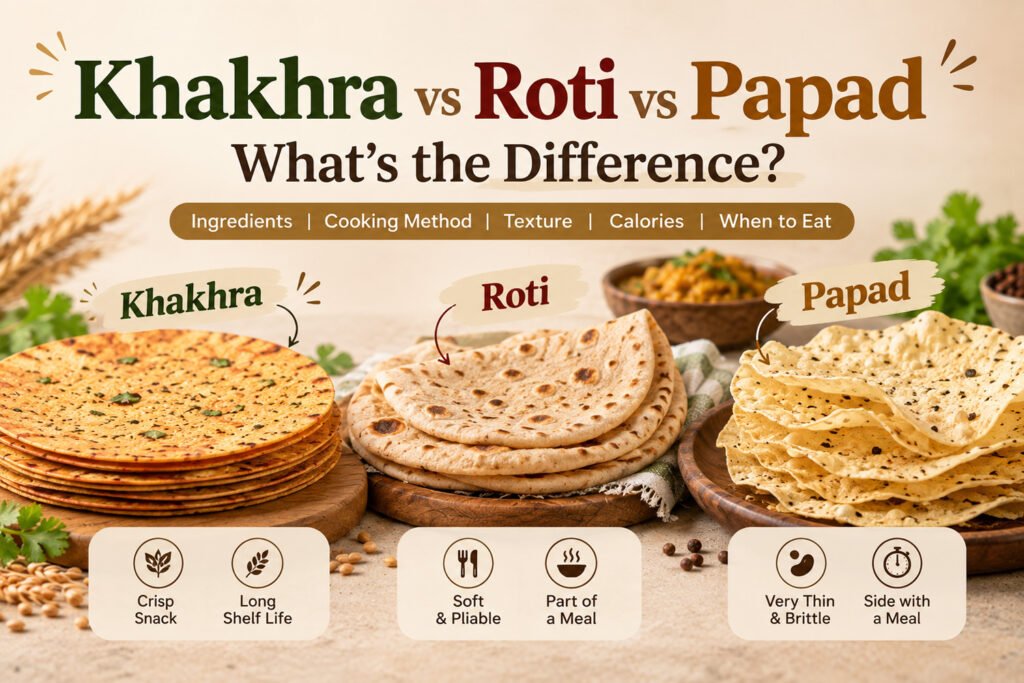
Oct
They’re all flat. They’re all Indian. They’re all made from flour. And people mix them up constantly — including people who’ve eaten all three their whole lives without ever being asked to explain the difference.
Here’s the clear version.
The short answer
| Khakhra | Roti | Papad | |
|---|---|---|---|
| Main flour | Whole wheat | Whole wheat | Lentil, gram or rice flour |
| Cooking method | Dry-roasted and pressed | Cooked briefly on a tava | Fried, roasted or flame-cooked |
| Texture | Thin, crisp, shatters | Soft, pliable | Very thin, brittle |
| Moisture | Almost none | High | Almost none |
| Eaten as | A snack, on its own | Part of a meal | A side with a meal |
| Shelf life | Months | Hours | Months |
| Needs anything with it? | No | Yes — dal, sabzi, curry | Usually eaten alongside a meal |
The single clearest distinction: khakhra and roti start from nearly the same dough; papad doesn’t. Papad is made from a completely different flour family.
What each one actually is
Khakhra
A thin, unleavened wheat flatbread, rolled very thin and dry-roasted while being pressed until almost all moisture is gone. The result is brittle and crisp, and keeps for months without refrigeration.
Khakhra is a snack. It’s eaten on its own, with tea, with pickle or chhunda, or topped as chaat. It doesn’t accompany a meal — it is one, in miniature. Our complete guide to khakhra covers it in full.
Roti
Also called chapati or phulka. The same basic wheat dough, rolled thicker and cooked briefly on a hot tava — typically under a minute — so it stays soft and pliable.
Roti is part of a meal. It exists to be torn and used to pick up dal, sabzi or curry. Eaten alone, it’s fairly plain, which is the point: it’s a vehicle, not a destination.
Papad
Made from a different flour entirely — usually urad or moong lentil, sometimes gram or rice flour — rolled extremely thin, sun-dried, then cooked just before eating by frying, roasting over a flame or microwaving.
Papad is an accompaniment. It adds crunch and salt to a plate of food. It’s rarely the thing you sit down to eat.
And bhakhri, while we’re here
Bhakhri is the fourth member of this family and gets left out of the conversation. It’s thicker and sturdier than roti, cooked longer, and sits somewhere between roti and khakhra in texture — firm rather than crisp. Our plain bhakhri is a good example.
How the cooking changes everything
This is where the real difference lies, and it’s smaller than people assume.
Khakhra and roti begin from nearly the same dough. Wheat flour, water, a little fat, salt. What separates them is entirely in the rolling and the cooking.
- Roti: rolled moderately thin, cooked 30–60 seconds, puffs with steam, stays soft
- Khakhra: rolled much thinner, cooked 2–3 minutes while being pressed continuously, pressed specifically so it can’t puff, loses nearly all moisture
That pressing is the whole technique. It forces steam out instead of letting it inflate the bread. Remove the moisture and you get shelf life and crispness; keep it and you get softness and a few hours of life. Our post on handmade vs. machine-made khakhra covers the pressing in detail.
Papad is a different process entirely. The dough is lentil-based, rolled far thinner than either, then dried rather than cooked — and only cooked at the moment of eating.
Comparing nutrition – and why most comparisons get it wrong
Here’s where almost every article on this topic misleads people.
Comparing these three per 100g is meaningless. Khakhra and papad are bone dry. Roti is roughly a third water. So 100g of khakhra is a large pile of khakhra, while 100g of roti is two or three rotis. Per 100g, khakhra looks far more calorie-dense than roti — not because it’s richer, but because the water has been removed.
The fair comparison is per piece, which is how people actually eat them.
| Per piece | Approximate calories |
|---|---|
| Khakhra (one small piece) | 35–50 |
| Roti (one medium) | ~100–120 |
| Papad, roasted | ~35–40 |
| Papad, fried | ~60–80 |
Khakhra figures are from our own range. Roti and papad figures are general approximate ranges — both vary considerably with size, flour and preparation.
What this shows: a khakhra is a snack-sized portion, and a roti is a meal component. They aren’t competing. Comparing them is a little like comparing a cracker to a slice of bread.
The one real nutritional distinction worth knowing: khakhra is roasted and absorbs no oil during cooking, while fried papad absorbs a significant amount. Roasted papad doesn’t. If you’re choosing between papads, that’s the choice that matters.
For a full breakdown of khakhra by flavour, see our calories and nutrition guide.
Shelf life: the practical difference
| Keeps for | |
|---|---|
| Khakhra | ~4–6 months unopened; 2–3 weeks once opened and stored airtight |
| Roti | Hours. Best within minutes of cooking |
| Papad | Months uncooked; minutes once fried or roasted |
This is why khakhra became Gujarat’s travel food and roti never did. A merchant travelling for weeks could carry khakhra. Roti had to be made fresh every day.
Papad sits in between — the uncooked disc keeps for months, but once cooked it goes soft quickly.
Keeping khakhra crisp is its own small skill — our storage guide covers it.
Which should you reach for?
Choose khakhra when you want something to eat on its own — with chai, in a lunchbox, on a journey, or as a base for chaat. It needs nothing else and keeps for months. Start with plain khakhra or methi if you’re new to it.
Choose roti when you’re eating a meal with dal, sabzi or curry. Nothing else does that job.
Choose papad when a plate of food needs crunch and salt alongside it. Our papad mix is a ready option.
Choose bhakhri when you want something sturdier than roti that still works as part of a meal, or that travels better.
Frequently asked questions
Is khakhra the same as roti?
No. They start from similar wheat dough, but roti is cooked briefly and stays soft, while khakhra is rolled much thinner and roasted for two to three minutes under pressure until nearly all moisture is gone. Roti lasts hours; khakhra lasts months.
What is the difference between khakhra and papad?
Khakhra is made from wheat flour and dry-roasted on a tava. Papad is made from lentil, gram or rice flour, dried rather than cooked, then fried or roasted just before eating. Khakhra is a snack in itself; papad accompanies a meal.
Which is healthier, khakhra or papad?
It depends on preparation. Khakhra is always roasted and absorbs no oil during cooking. Roasted papad is similarly light, while fried papad absorbs significant oil. Roasted papad and khakhra are broadly comparable; fried papad is the heaviest of the three.
Is khakhra just a crispy roti?
Not quite. The dough is similar, but khakhra is rolled thinner and pressed continuously during roasting to prevent it puffing — which is what produces its layered, shattering texture. A roti left on the tava too long goes hard, not crisp.
What is the difference between khakhra and bhakhri?
Bhakhri is thicker and firmer, cooked longer than roti but not pressed dry like khakhra. It’s sturdy rather than crisp, and usually eaten as part of a meal rather than as a snack.
Can khakhra replace roti in a meal?
Not really. Roti is soft enough to tear and scoop with, which khakhra isn’t. Khakhra works better alongside a meal, or as a snack on its own.
Why does khakhra last so much longer than roti?
Because nearly all its moisture is roasted out. Moisture is what allows food to spoil, so removing it gives khakhra months of shelf life where roti has hours.
