


Gujarati Food Culture
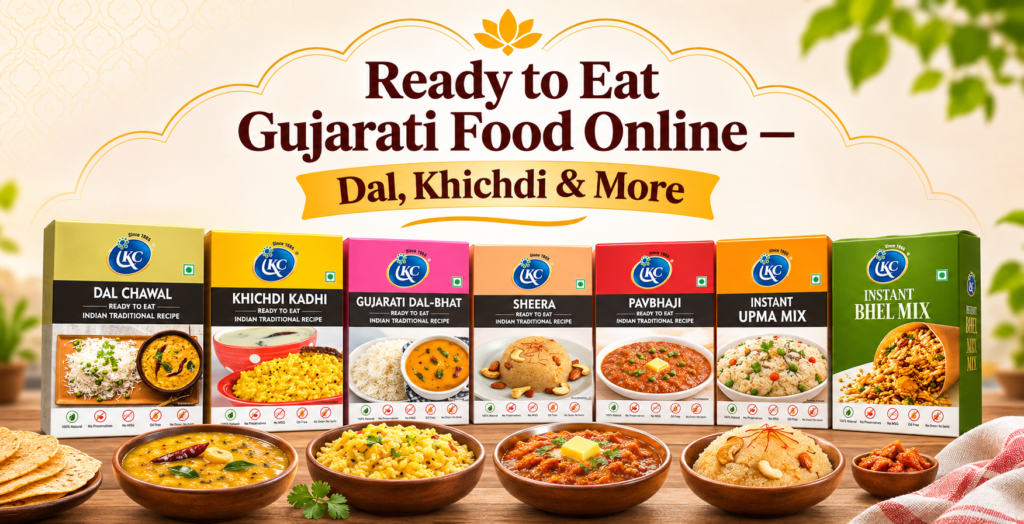
Ready to Eat Gujarati Food Online – Dal, Khichdi & More
Nov
There is a particular kind of hunger that hits a student in a foreign city at eleven at night, or someone back from work too late to cook, or a traveller three days into a trip where nothing has tasted like home.
Ready-to-eat Gujarati food exists for exactly those moments. Not as a replacement for a proper meal, but as a genuine answer when cooking one isn’t going to happen.
This guide covers what ready-to-eat Indian food actually is, how it keeps without refrigeration, who it suits, and what to look for when buying.
What is ready-to-eat food?
Ready-to-eat meals are fully cooked dishes, sealed in retort pouches and sterilised so they keep at room temperature without preservatives or refrigeration.
The process is closer to canning than to freezing. The dish is cooked, sealed into a multi-layer pouch, then heat-treated at high temperature to make it shelf-stable. Nothing needs to be added to keep it safe.
To eat, you warm the pouch in hot water or empty it into a pan for a couple of minutes. No cooking, no chopping, no cleanup beyond one bowl.
Why people buy it
Students abroad. The single largest reason. A student in a shared kitchen with no Indian grocery nearby, in the middle of exams, is not going to make dal from scratch. A pouch of dal bhat takes three minutes.
Travel. Sealed, light, room-stable and compliant with most hand-luggage rules for solids. It survives a journey that fresh food would not.
Elderly parents living alone. A reliable hot meal without standing at a stove.
Late nights and long weeks. Anyone who has stood in front of an empty fridge at ten o’clock knows the use case.
Pilgrimage and religious travel. Places where finding food that meets dietary requirements is genuinely difficult.
The range
Full meals
Gujarati dal bhat — the everyday Gujarati plate, dal and rice together.
Khichdi kadhi — the comfort meal of Gujarat, and the thing people ask for when they are unwell or homesick.
Dal chawal — the north Indian counterpart.
Punjabi classics
Paneer butter masala — the most ordered Indian dish in the world, in a pouch.
Palak paneer — spinach and paneer.
Dal makhani — slow-cooked black lentils.
Paneer bhurji — scrambled paneer, good with bread or roti.
Street food and breakfast
Pav bhaji — Mumbai’s defining street dish.
Upma mix — a south Indian breakfast staple.
Instant bhel — everything for bhel puri in one pack.
Sweet
Sheera — semolina halva, warm and quick.
How to eat it properly
A few things make a noticeable difference.
Heat the pouch in water rather than a microwave where you can. It warms evenly and the texture holds better.
Finish it fresh. A spoon of ghee, a squeeze of lemon, chopped coriander, or sliced raw onion alongside. Thirty seconds of effort and it stops tasting like a packet.
Eat it with something with texture. This matters more than people expect. Ready-to-eat dishes are soft by nature, and a plate of nothing but soft food gets dull fast. Khakhra, bhakhri or thepla alongside turns a pouch into a meal.
Keep pickle and chhunda to hand. Mango chhunda or a spoon of pickle lifts almost anything.
What to check before buying
Shelf life and manufacturing date. Retort pouches keep for months, but fresher is better — the texture of pulses in particular softens over time.
Ingredients, not just the name. If you are buying for a Jain household, check for onion and garlic rather than assuming. Our guide to Jain-friendly snacks covers what to look for.
Pouch integrity. A swollen or damaged pouch should be discarded, not opened.
Portion size. Most single pouches suit one person with something alongside, or two people as part of a larger spread.
Sending it abroad
Ready-to-eat pouches are among the more practical things to post or carry to family overseas: sealed, room-stable and reasonably robust.
Two things to keep in mind. Food import rules vary by country and change periodically, so check the destination’s requirements before sending. And ship earlier than feels necessary — international transit slows considerably around festival periods.
Frequently asked questions
What is ready-to-eat food?
Ready-to-eat meals are fully cooked dishes sealed in retort pouches and heat-sterilised so they stay safe at room temperature without refrigeration. They are warmed in hot water or a pan for a few minutes before eating.
Does ready-to-eat Indian food contain preservatives?
Properly made retort-pouch food does not need preservatives — the sterilisation and sealed pouch are what keep it stable. Check the ingredients list on any pack to be sure.
How long does ready-to-eat food last?
Typically several months unopened at room temperature. Check the pack for the manufacturing and best-before dates, and discard any pouch that is swollen or damaged.
How do you heat ready-to-eat meals?
Immerse the sealed pouch in boiling water for a few minutes, or empty the contents into a pan and warm through. Heating in water generally gives a better texture than a microwave.
Is ready-to-eat food good for students abroad?
It is one of the most practical options — no cooking skill or equipment needed, no refrigeration, long shelf life, and it travels well in a suitcase.
What should I eat with ready-to-eat dal or curry?
Something with texture. Khakhra, bhakhri or thepla alongside makes a far more satisfying plate than the pouch alone, and all three keep for months.
Shop ready-to-eat and what goes with it
- Instant Ready to Eat — the full range of pouches
- Khakhra — texture alongside anything soft
- Bhakhri — sturdier, and good with dal
- Pickles & Chhunda — the easiest way to lift a pouch meal
- Mukhvas — to finish
Browse everything in our online store. See also our guides to bhakhri and Jain-friendly snacks.
