


Gujarati Food Culture
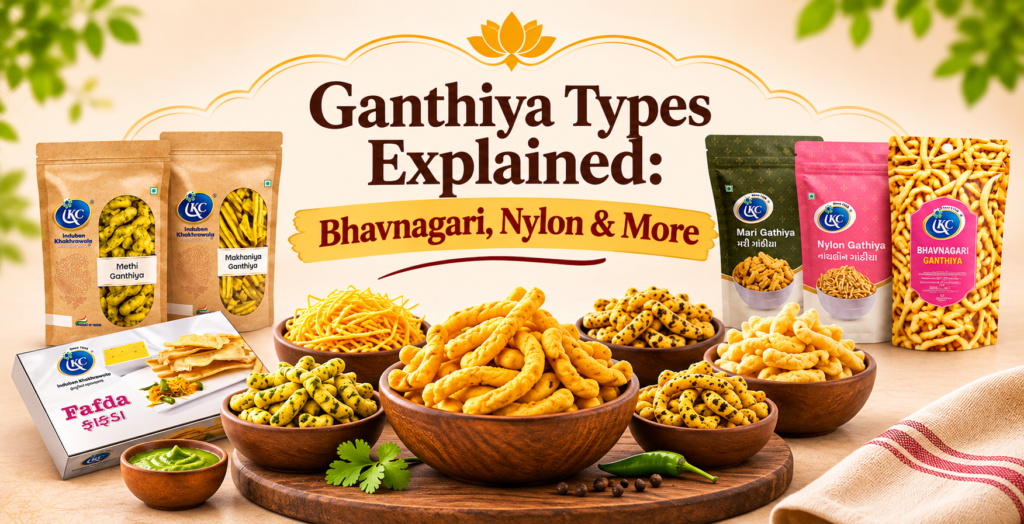
Ganthiya Types Explained: Bhavnagari, Nylon & More
Nov
Ask anyone outside Gujarat what ganthiya is and you will usually be told “it’s like sev”. It isn’t, and the difference matters.
Ganthiya is thicker, softer and chewier. Sev is fine and brittle. They are made from the same gram flour and they sit on the same shelf, but they are different foods with different uses — and within ganthiya alone there are half a dozen distinct styles that Gujarati households treat as separate things entirely.
This guide covers what ganthiya actually is, how the main varieties differ, and which one to reach for when.
What is ganthiya?
Ganthiya is a fried Gujarati snack made from gram flour (besan), pressed into thick strands and fried until just set.
The texture is the defining feature. Good ganthiya is not brittle. It yields slightly when you bite it, with a soft, almost crumbly interior — the result of a looser dough and a shorter fry than you would give sev.
It belongs to the wider family of Gujarati farsan, the savoury snacks eaten with afternoon tea, served alongside a thali, and put out whenever guests arrive.
Ganthiya vs sev: the difference
| Ganthiya | Sev | |
|---|---|---|
| Thickness | Thick strands | Fine, thread-like |
| Texture | Soft, yielding, slightly chewy | Crisp and brittle |
| Eaten | On its own, by the handful | On its own or as a topping |
| Dough | Looser, more aerated | Firmer, pressed finer |
| Best with | Tea, fried chillies, chutney | Chaat, bhel, dahi dishes |
The simplest test: if you can crush it to powder between your fingers, it is sev. If it bends before it breaks, it is ganthiya.
The main varieties
Bhavnagari ganthiya
From Bhavnagar, and the style most people mean when they say ganthiya without qualifying it. Thick, soft, mildly salted, and made to be eaten in quantity. Bhavnagari ganthiya is the benchmark — if you are trying ganthiya for the first time, start here.
Nylon ganthiya
Despite the unpromising name, this is the lightest and most delicate of the range. Finer than Bhavnagari, airier, and quicker to eat. The name refers to the thin, almost translucent quality rather than anything synthetic. Nylon ganthiya suits people who find the standard style too dense.
Mari vanela ganthiya
Made with crushed black pepper worked through the dough. The pepper is warm rather than sharp, and it comes through on the finish rather than the first bite. Mari vanela ganthiya is the one to reach for if plain ganthiya feels too mild.
Makhaniya ganthiya
Softer and richer than the rest, with a shorter, more buttery crumb. The name points at that texture. Makhaniya ganthiya is a favourite with older eaters and anyone who prefers a gentler bite.
Methi ganthiya
Fenugreek kneaded into the dough gives a mild, pleasant bitterness that cuts the richness of the fry. Special methi ganthiya is the most distinctly Gujarati flavour in the range.
And fafda, which is related but separate
Fafda is flat and wide rather than round-strand, with a chewier pull. It is made from the same gram flour base but shaped and fried differently. Fafda has its own cultural moment — on Dussehra morning, Gujarat eats fafda and jalebi for breakfast, in enormous quantities, from queues that form before the shops open.
Which ganthiya should you buy?
First time? Bhavnagari. It is the standard against which the others are judged.
Want something lighter? Nylon ganthiya.
Want more flavour? Mari vanela for pepper, methi for herb.
Buying for elders? Makhaniya — the softest texture of the range.
Buying for a gift box? A mix. Part of the pleasure of Gujarati farsan is having several kinds open at once.
How to eat ganthiya
With chai, in the afternoon. The default, and what it is made for.
With fried green chillies. The traditional accompaniment, and worth trying at least once.
With papaya chutney. Standard alongside fafda, and it works with ganthiya too.
As part of a thali. A small portion alongside dal and rotli is normal in a Gujarati meal.
With khakhra. Ganthiya and khakhra together make something close to a light meal.
Storing ganthiya
Fried farsan goes stale two ways: moisture softens it, and the oil eventually turns rancid.
- Airtight containers, always. Decant as soon as you open the packet.
- Cool and dark, away from the stove.
- Never refrigerate. Condensation ruins it faster than leaving it out.
- Smell before eating anything old. Fried farsan goes rancid before it looks any different. A sharp, stale, faintly paint-like smell means discard it.
- Buy smaller quantities in monsoon. Humidity is harder on fried farsan than on khakhra.
Frequently asked questions
What is ganthiya?
Ganthiya is a fried Gujarati snack made from gram flour pressed into thick strands. Unlike sev it is soft and slightly chewy rather than brittle, and it is eaten on its own with tea rather than used as a topping.
What is the difference between ganthiya and sev?
Ganthiya is thicker, softer and chewier; sev is fine and crisp. Both are made from gram flour. Ganthiya is eaten by the handful, while sev is often used as a topping for chaat and bhel.
What is Bhavnagari ganthiya?
Bhavnagari ganthiya comes from Bhavnagar in Gujarat and is the thick, soft, mildly salted style most people mean when they refer to ganthiya without qualifying it.
Why is it called nylon ganthiya?
The name refers to how fine and light the strands are, not to any ingredient. Nylon ganthiya is the most delicate variety.
What is the difference between ganthiya and fafda?
Fafda is flat and wide with a chewier pull; ganthiya is a rounder, thicker strand. Both are gram flour based, shaped and fried differently.
How long does ganthiya last?
Several weeks in an airtight container. It goes rancid rather than mouldy, so smell is the test rather than appearance.
Shop the farsan range
- Premium Namkeen — ganthiya, sev, chevdo, fulvadi and the wider farsan range
- Khakhra — the natural partner to ganthiya with afternoon tea
- Masala & Chutney — for serving alongside
- Sweets — including jalebi-style mithai for the Dussehra pairing
Browse everything in our online store. See also our guides to bhakhri and Gujarati mithai.
