


Khakhra, Khakhra Guides
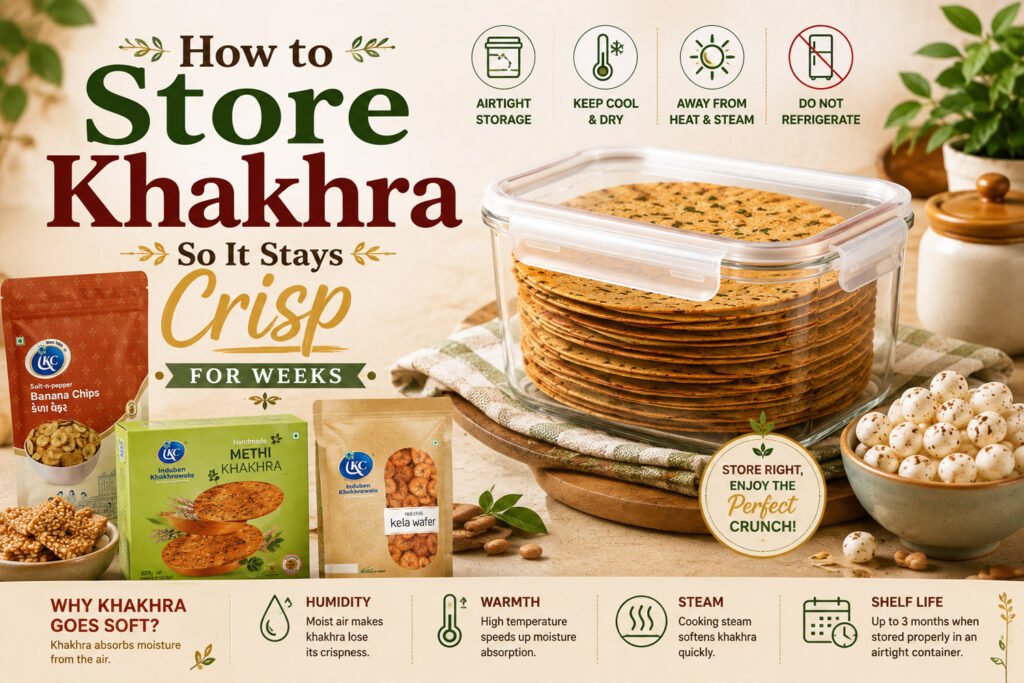
How to Store Khakhra So It Stays Crisp
Sep
Khakhra has one weakness, and everyone who buys it discovers it eventually: leave a packet open for a few days and the crispness disappears. What was sharp and shattering becomes bendy and disappointing.
The good news is that this is almost always a storage problem, not a quality problem — and it’s both preventable and, in most cases, reversible. Here’s what’s actually happening and what to do about it.
Why khakhra goes soft
Khakhra is made by roasting out nearly all the moisture. That’s the entire point of the process, and it’s what gives khakhra its long shelf life and its snap. If you want the full picture of how it’s made, our complete guide to khakhra covers it.
But dry things don’t stay dry. Khakhra pulls moisture out of the air around it, and it does so faster than most people expect. In a humid room, an open packet can lose its crispness in a couple of days.
Three things accelerate it:
- Humidity. The single biggest factor, and why monsoon is hard on khakhra.
- Warmth. Warm air holds more moisture and speeds absorption.
- Steam. A packet stored near the stove is absorbing moisture every time you cook.
Nothing has gone wrong with the khakhra. It has simply done what dry food does when left in contact with air.
The rules
1. Decant into an airtight container as soon as you open the packet. This is the one that matters most. The original packet, once opened, is not airtight even if you fold or clip it. Glass or steel with a proper seal is ideal; a good plastic container works.
2. Keep it cool and dark. A cupboard away from heat. Not on the counter, not in sunlight.
3. Keep it away from the stove. Cooking steam is the fastest way to soften a whole container. This catches out many households, because the snack cupboard is often the nearest one to the hob.
4. Never refrigerate. This is the mistake worth repeating. The fridge is humid, and every time you take the container out, condensation forms on cool khakhra as it meets warm air. The fridge will ruin a packet faster than leaving it on the counter.
5. Don’t store it with anything moist. Khakhra will pull moisture out of whatever it’s sharing space with. Don’t box it with fresh snacks, and in a tiffin, keep it separate from chutney or curd.
6. Keep the container full. A container that’s mostly air holds more moisture. As you work through a large pack, move the remainder into a smaller container.
How long khakhra actually lasts
| Duration | |
|---|---|
| Unopened, commercially packed | Approximately 4–6 months from manufacture |
| Opened, airtight container | 2–3 weeks at good crispness |
| Opened, original packet folded over | A few days |
| Opened, humid conditions | Sometimes 24 hours |
Approximate figures — check the pack for the manufacturing and best-before dates.
The gap between the second and third rows is the entire argument for decanting.
How to bring soft khakhra back
Soft khakhra is not spoiled khakhra. It has absorbed moisture, and moisture can be driven back out.
On a tava — the best method. Dry pan, low flame, 20–30 seconds each side. Don’t add oil. It will crisp as it cools, so take it off slightly before it seems ready.
In an oven. Low heat, around 150°C, for 2–3 minutes. Good for reviving several at once. Watch it — khakhra goes from crisp to burnt quickly.
In an air fryer. 150°C for about 2 minutes. Works well.
A word on the microwave. It can work — 20–30 seconds, then leave it out to cool completely — but it’s the least reliable method and easy to overdo. If you have a tava, use the tava.
The step everyone skips: let it cool completely before eating or repacking. Khakhra crisps as it cools, not while it’s hot. Repack it warm and you’ll trap steam and be back where you started within a day.
Monsoon storage
Between June and September, ordinary storage stops being enough. Humidity climbs and khakhra softens in hours rather than days.
- Buy smaller packs through monsoon rather than bulk
- Use the smallest container that fits what you have
- Add a food-safe silica sachet if your khakhra came with one — keep it in the container
- Crisp on a tava before serving, and treat it as normal rather than a rescue
- Tinned formats hold up better. Our khakhra shots come in resealable tins, which handle humidity considerably better than a folded pouch
Bulk buying and long storage
If you’re buying 500g packs or several flavours at once:
- Keep unopened packs sealed and store them somewhere cool and dark. They’ll hold for months.
- Open one at a time. Don’t open four flavours and work through them slowly — that’s four packets going soft in parallel.
- Decant the open one into a right-sized airtight container.
- Note the manufacturing date when you buy so you know which to open first.
How to tell if khakhra has actually gone off
Soft khakhra is fine to eat. Genuinely spoiled khakhra is different, and worth knowing how to spot.
Khakhra rarely grows mould, because it’s too dry. What actually happens as it ages is that the oil or ghee in it oxidises and turns rancid.
The test is smell. Fresh khakhra smells toasted and faintly of wheat. Rancid khakhra has a sharp, stale, faintly paint-like smell — unmistakable once you’ve noticed it. It also tastes bitter at the back of the throat.
If it smells off, don’t eat it, and don’t try to revive it. Heating rancid khakhra doesn’t fix rancidity.
If you ever see mould, discard the whole container. That means moisture got in, and where one piece is affected others likely are too.
Storing khakhra abroad
Khakhra travels well, which is why so much of it ends up in suitcases — see our guide to Indian snacks for flights.
In dry climates — much of Europe, North America in winter, dry parts of the Middle East — khakhra keeps beautifully. Often better than in India.
In humid climates — Singapore, Hong Kong, coastal Australia, the American south in summer — treat it like Indian monsoon. Airtight containers, small quantities open at a time.
In centrally heated homes, the air is very dry, which suits khakhra well. Just keep it away from radiators.
Frequently asked questions
How do I keep khakhra crisp? Decant it into an airtight container as soon as you open the packet, keep it cool, dark and away from the stove, and never refrigerate it. The original packet, once opened, isn’t airtight even folded over.
Why did my khakhra go soft? It has absorbed moisture from the air. Khakhra is made by roasting nearly all the moisture out, so it readily pulls moisture back in — especially in humid weather or if stored near a stove.
Can I put khakhra in the fridge? No. The fridge is humid, and condensation forms on the khakhra each time it comes out into warm air. Refrigerating khakhra makes it soft faster than leaving it in a cupboard.
How do I make soft khakhra crisp again? Warm it on a dry tava on low flame for 20–30 seconds each side, or in an oven at around 150°C for 2–3 minutes. Let it cool completely before eating — khakhra crisps as it cools, not while hot.
How long does khakhra last? Approximately 4–6 months unopened, and 2–3 weeks at good crispness once opened and stored in an airtight container.
Does khakhra expire or go bad? Khakhra rarely moulds because it’s too dry. It goes rancid instead, as the oil or ghee oxidises over time. Fresh khakhra smells toasted; rancid khakhra smells sharp and stale and tastes bitter.
How should I store khakhra during monsoon? Buy smaller packs, use the smallest airtight container that fits, and crisp it on a tava before serving. Tinned formats hold up better than pouches in high humidity.
