


Gujarati Food Culture
Gujarati Snacks Shop in Ahmedabad: What to Try, and What to Take Home
Oct
Ahmedabad takes snacking more seriously than most cities take dinner.
There’s a whole category of eating here that sits between meals — farsan, eaten in the afternoon with tea, offered the moment a guest sits down, packed into boxes for anyone travelling. For visitors, working out what to try and what to take home can be genuinely confusing, because the variety is enormous and most of it has no English name.
This guide is a starting point: what Ahmedabad’s snack tradition actually consists of, what’s worth trying fresh, what travels well, and how to tell a good farsan shop from an average one.
Why Ahmedabad is a snacking city
Gujarati food culture places real weight on what’s eaten between meals. Farsan — the savoury snacks of Gujarat — isn’t an afterthought here. It’s a recognised category with its own shops, its own specialists and its own seasons.
A few things follow from that:
Snack shops are specialists, not corner shops. A proper farsan shop makes things fresh, often daily, and will have varieties you won’t find three streets away.
Freshness is visible. Fried farsan is at its best within days. Shops that turn over stock quickly taste noticeably better than shops that don’t.
Variety is the point. A household will keep several kinds at once — something crisp, something soft, something sweet, something for the children.
If you want the full picture of the category, our guide to Gujarati farsan covers every major type.
What to try while you’re here
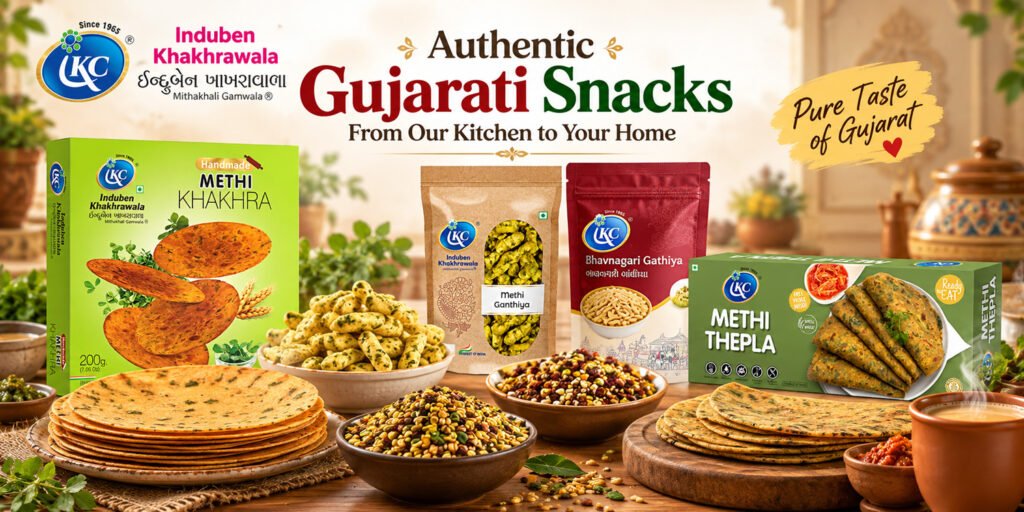
Khakhra
The thin, crisp, roasted wheat cracker that Gujarat is best known for, and the thing most visitors take home. It keeps for months, travels without damage and needs nothing with it.
Start with methi khakhra — fenugreek, mildly bitter, and the most popular flavour in Gujarat by some distance. If you want to judge quality properly, try plain khakhra, where there’s no seasoning to hide behind.
Our complete guide to khakhra explains how it’s made and why handmade differs from machine-made.
Ganthiya
Thick, soft-crisp strands of fried gram flour, and distinctly Gujarati — quite different from the thin sev found across the rest of India. Bhavnagari ganthiya is the classic; mari vanela adds black pepper.
Fafda
Flat, wide, chewy gram-flour strips. Eaten year-round, but it has one particular morning that belongs to it entirely — see below.
Chevdo
Gujarat’s mixtures, usually built on flattened rice with nuts, curry leaves and spices. Khatta mitha chavana — sweet and sour — is the one most visitors end up buying twice.
Thepla
Soft, spiced flatbread, the other great Gujarati travel food. Methi thepla keeps for days and is what every Gujarati family packs for a journey.
Mukhvas
The after-meal mouth freshener — seeds, sugar-coated fennel, sometimes silver leaf. Served at the end of a meal across Gujarat, and an easy thing to take home. We make nine varieties, including gujarati mix and tal gotli.
The festival calendar
Ahmedabad’s snack year has fixed points, and timing a visit around one changes what you’ll find.
Dussehra morning — fafda and jalebi. Gujarat eats fafda and jalebi for breakfast on Dussehra, in enormous quantities, from queues that form before the shops open. The salty, chewy fafda against hot syrup-soaked jalebi works far better than it sounds. If you’re in Ahmedabad that morning, go early.
Navratri — farali food. During the nine nights of Navratri, many people fast, which means no grains or pulses. The city shifts to fasting-appropriate food, and ordinary farsan largely disappears from fasting households. Our farali guide explains what’s permitted and what isn’t.
Diwali — sweets and gift boxes. The busiest snack-buying period of the year. Shops expand their sweet ranges and gift hampers appear everywhere.
Uttarayan (mid-January) — kite festival. Rooftops, kites, and all-day snacking. Chikki and til-based sweets come into their own in the cold-weather months.
How to judge a good farsan shop
Useful whether you’re buying from us or anyone else.
Ask when it was made. A shop that knows, and tells you, is a shop that turns over stock. Fried farsan is best within days.
Look at the variety of ganthiya. Anywhere offering several distinct kinds — thick, fine, peppered, methi — is a specialist rather than a reseller.
Check whether they make or buy. Shops that produce their own know their product. Resellers often can’t tell you much about it.
Buy small first. Try one or two varieties before committing to a large box. Gujarati farsan has a wider range of textures than most people expect, and preferences are personal.
Smell, don’t just look. Fried farsan goes rancid before it looks any different. Fresh should smell clean and toasted.
What travels well
If you’re taking snacks back — to another Indian city, or abroad:
| Travels well | Doesn’t travel |
|---|---|
| Khakhra — months, and survives a suitcase | Fresh mithai |
| Dry farsan, ganthiya, sev, chevdo | Anything fried that day and unsealed |
| Thepla — several days | Steamed farsan: dhokla, khandvi |
| Mukhvas — indefinitely | Anything with high moisture |
| Chikki and dry sweets |
Pack khakhra in a rigid container, not loose in a bag. It’s crisp, which also means it’s fragile.
Our guide to Indian snacks for flights covers what to carry and what to expect at security.
Where to find us in Ahmedabad
We’ve been making khakhra in Ahmedabad since 1965 – six decades, from one kitchen to more than twenty outlets.
Click here to view all outlets
You’ll also find us at Ahmedabad Airport — details here — which is where most of our travelling customers pick something up on the way out.
Not in Ahmedabad? We ship across India from our online store.
Frequently asked questions
What snacks is Ahmedabad famous for?
Khakhra, ganthiya, fafda, chevdo, thepla and a wide range of farsan — the savoury snacks of Gujarati cuisine. Khakhra is the one most visitors take home, because it keeps for months and travels well.
What should I buy in Ahmedabad to take home?
Khakhra, dry farsan such as ganthiya and chevdo, thepla and mukhvas all travel well. Avoid fresh mithai and steamed farsan such as dhokla, which don’t survive a journey.
What is farsan?
Farsan refers to the savoury snacks of Gujarati cuisine, typically gram-flour based and either fried, steamed or roasted. It includes dry packaged snacks like ganthiya and sev as well as fresh steamed items like dhokla.
Why do people eat fafda and jalebi on Dussehra in Gujarat?
It is a long-standing Gujarati tradition, usually explained as marking the end of the Navratri fasting period. The salty chewy fafda balances the hot syrup-soaked jalebi.
How long does khakhra last?
Approximately 4–6 months unopened, and two to three weeks once opened and kept in an airtight container — which is why it’s the standard thing to carry home.
Where can I buy good khakhra in Ahmedabad?
Look for a shop that makes its own rather than reselling, offers several khakhra varieties, and can tell you when a batch was made. We’ve been making khakhra in Ahmedabad since 1965.
