


Khakhra
Khakhra Calories and Nutrition: A Complete Guide by Flavour
Aug
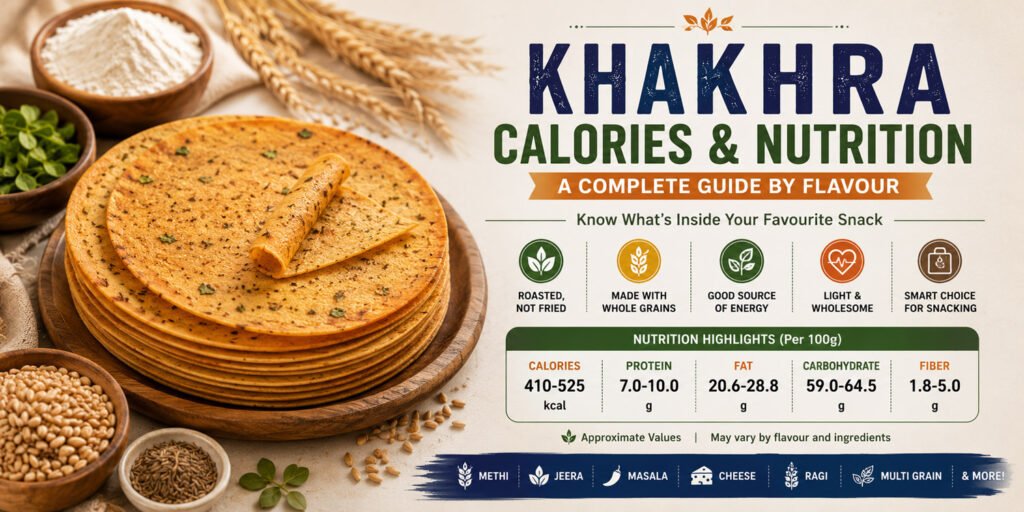
“How many calories in a khakhra?” is one of the most searched questions about the snack — and most answers online give a single number with no explanation, which is close to useless when khakhra varies in size, flour and fat content from one variety to the next.
Here is the honest, detailed version: what a khakhra actually contains, how the flavours differ, how it genuinely compares to other Indian snacks, and what the numbers do and don’t tell you. If you are new to the snack itself, start with our complete guide to what khakhra is and come back here for the detail.
The short answer
A single small khakhra contains roughly 35 to 50 calories, depending on its size, the flour used, and how much oil or ghee went into the dough.
For most people that means:
- A standard 2-piece serving: roughly 70–100 calories
- A generous 4-piece tea-time portion: roughly 140–200 calories
That is the number most people are looking for. But it is worth understanding why the range is as wide as it is, because the difference between the bottom and the top of that range is nearly 50%.
Why khakhra calories vary so much
Four things move the number.
1. Size and thickness. This is the biggest factor by far, and the one nobody mentions. A large, thick khakhra can easily contain twice the calories of a small thin one. Any calorie figure quoted without a weight is close to meaningless — always check the grams per piece on the pack.
2. The flour. Whole wheat is the standard. Millet flours such as ragi, bajri and moth bean shift the nutritional profile — often similar in calories, but meaningfully different in fibre, protein and micronutrients.
3. The fat. Khakhra is roasted, not fried, so there is no oil absorption during cooking. But oil or ghee goes into the dough, and how much varies enormously — from 16.7g to 28.8g per 100g across our range. Diet varieties sit at the bottom of that range by design; plain, pure ghee and ragi sit at the top.
4. The flavouring. Cheese, masala blends and chaat-style seasonings add a small amount. Methi, jeera and mint add almost nothing.
Calories by khakhra variety
Here is how our range breaks down, per 100g. Khakhra is a very dry, dense product, so per-100g figures look high — always divide down by the per-piece weight on the pack.
| Variety | Calories (kcal/100g) | Protein (g) | Fat (g) | Fibre (g) |
|---|---|---|---|---|
| Math khakhra | 450 | 10.0 | 18.0 | 4.0 |
| Bajri methi khakhra | 455 | 8.5 | 19.0 | 3.5 |
| Methi khakhra | 457 | 8.2 | 20.6 | 1.8 |
| Masala diet khakhra | 469 | 9.3 | 16.7 | 1.2 |
| Jeera khakhra | 470 | 9.0 | 21.0 | 2.0 |
| Masala khakhra | 475 | 9.0 | 21.5 | 2.0 |
| Ragi khakhra | 481 | 7.9 | 28.8 | 2.2 |
| Cheese khakhra | 500 | 12.0 | 25.0 | 2.0 |
| Plain khakhra | 525 | 10.0 | 27.5 | 2.5 |
| Pure ghee khakhra | 525 | 10.0 | 27.5 | 5.0 |
Sorted lowest to highest calorie.
Note: The nutritional values above are approximate, for general reference. Actual values may vary depending on ingredients, recipe, preparation method and serving size. Please check the product packaging for the most accurate nutritional information.
What the numbers actually show — including a few things that surprise people:
- Lowest in calories: math khakhra at 450, followed by bajri methi and methi.
- Lowest in fat: masala diet khakhra at 16.7g — meaningfully below everything else, which is the whole point of a diet variety.
- Highest in protein: cheese khakhra at 12g, from the dairy content. Math, plain and pure ghee tie behind it at 10g.
- Highest in fibre: pure ghee khakhra at 5g, then math at 4g and bajri methi at 3.5g.
- Plain is not the lightest. Plain khakhra is joint-highest in calories and fat. It is the simplest khakhra, not the leanest — those are different things, and it is worth knowing which one you are actually buying.
- The best all-round balance is math khakhra. Lowest calories, joint-highest protein, second-highest fibre. If you are choosing on nutrition rather than taste, that is the one.
An honest comparison with other snacks
This is where most khakhra articles overstate the case, so let us be precise about it.
Per 100 grams, khakhra is not dramatically lower in calories than many fried snacks. Khakhra is extremely dry — almost all the water has been roasted out — so 100g of khakhra is a lot of khakhra. Weight for weight, the gap is smaller than the marketing usually suggests.
Nor is khakhra a low-fat food in absolute terms. Our varieties range from 16.7g to 28.8g of fat per 100g. The fat doesn’t come from frying — there is no frying — it comes from the oil or ghee worked into the dough, and it varies a great deal between varieties. Anyone telling you khakhra is a low-fat snack full stop is not looking at the panel.
What is true, and what actually matters:
Variety choice makes a real difference. Masala diet khakhra at 16.7g fat and math khakhra at 18g are in a different bracket from plain and pure ghee at 27.5g. That is a 40% difference within the same product category — a much bigger lever than khakhra-versus-anything-else.
Natural portion control. A khakhra is a discrete, countable object. You know whether you have eaten two or five. A bowl of mixture or sev offers no such feedback, and portions expand without anyone noticing. Two khakhras is 70–100 calories, and it is easy to know you have had two.
Satiety per calorie. Khakhra requires real chewing and takes time to eat. The higher-fibre varieties — pure ghee at 5g, math at 4g, bajri methi at 3.5g — slow things further.
Ingredient simplicity. Flour, oil or ghee, salt, spices. Not much room for anything else to hide.
If you want a genuinely low-calorie roasted alternative alongside khakhra, our makhana range — including mint and chaat flavours — is lighter again per portion.
Protein, fibre and the millet varieties
If you are choosing khakhra on nutrition rather than taste, this is the section that matters — and the numbers hold a few surprises.
Math khakhra is the strongest all-rounder in our range. Made from moth bean, a pulse rather than a grain, it comes in lowest on calories (450), joint-highest on protein (10g), and second-highest on fibre (4g) — while carrying notably less fat than most varieties at 18g. It also has a distinctly earthier, nuttier flavour, which is worth knowing before you commit to a large pack.
Bajri methi khakhra is the runner-up: 455 calories, 3.5g fibre, 19g fat. Pearl millet is a winter staple across Gujarat and Rajasthan, and this is the variety to reach for if you want a millet khakhra that genuinely delivers on fibre.
Ragi khakhra deserves a plain-spoken note. Finger millet has a strong reputation for calcium, iron and fibre — but our ragi khakhra measures 2.2g fibre and 28.8g fat per 100g, which puts it among the higher-fat, lower-fibre options here rather than the lighter ones. It has a lovely dark colour and a mild, malty flavour, and people buy it for the taste and the grain. Choose it for those reasons, not because you assume millet automatically means lighter.
Masala diet khakhra does exactly what its name promises on the metric that counts: at 16.7g, it has the lowest fat of anything we make. Its calories (469) sit mid-range, because reducing fat doesn’t reduce a dry wheat product’s energy density as much as people expect.
The broader point: within khakhra, the differences between varieties are real but moderate. Choosing math over plain saves you around 75 calories and 9.5g of fat per 100g. That is worth having — it is not a transformation.
How khakhra fits into different eating patterns
Some practical context, without turning this into a diet plan.
As a swap for fried snacks. This is where khakhra does the most obvious work. Replacing a fried evening snack with khakhra meaningfully cuts fat intake without asking anyone to eat something they don’t enjoy.
In a school tiffin. Filling, doesn’t spoil, doesn’t leak, doesn’t need reheating, and children actually eat it. Cheese and pav bhaji flavours are usually the easiest sell.
While travelling. Dry, sealed and stable, which is why khakhra has been Gujarat’s travel food for generations — see our guide to Indian snacks for flights.
If you are managing blood sugar. Whole wheat and millet varieties are generally more suitable than refined-flour snacks because of their fibre content, and roasting avoids added fat. Portion size still matters. Anyone managing diabetes should check with their doctor or dietitian about what fits their specific plan — general guidance is no substitute for that.
For a fuller discussion of the health question, including the caveats, read is khakhra actually healthy?
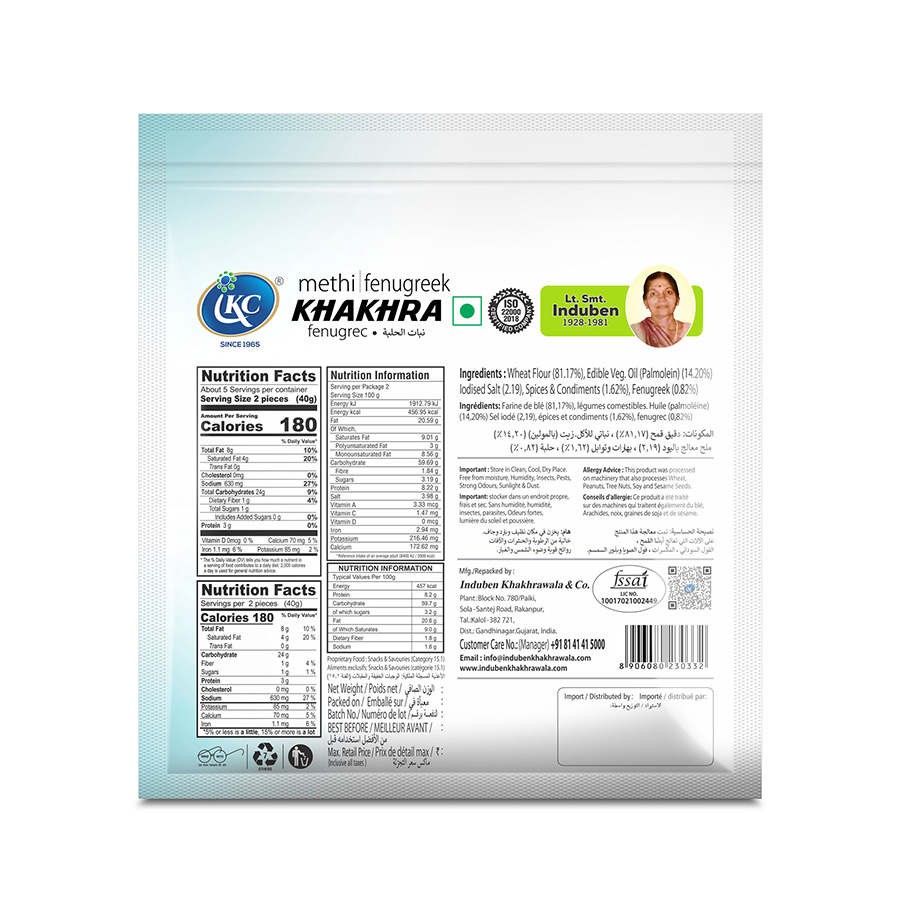
How to read a khakhra label properly
Three things to check, in order:
- Weight per piece, not just per 100g. Everything else follows from this. A pack quoting 400 kcal per 100g tells you nothing until you know whether a piece weighs 8g or 15g.
- Fat, and what kind. Look for oil or ghee named specifically. Vague terms such as “edible vegetable oil” tell you less than “groundnut oil” or “pure ghee”.
- Ingredient order. Ingredients are listed by weight, heaviest first. If the flour isn’t first, ask why.
Frequently asked questions
How many calories in one khakhra? Roughly 35 to 50 calories per small piece, depending on size, ingredients and oil content. Larger or thicker khakhras can exceed this — always check the per-piece weight on the pack.
Is khakhra low in calories? Per piece, yes — it is a modest, well-portioned snack. Per 100g it is comparable to many other dry snacks, because khakhra contains almost no moisture. Its main advantage is low fat, not low calories.
Which khakhra has the fewest calories? Math khakhra, at 450 kcal per 100g, followed by bajri methi at 455 and methi at 457.
Which khakhra has the least fat? Masala diet khakhra, at 16.7g per 100g — around 40% less fat than plain or pure ghee khakhra.
Which khakhra has the most protein? Cheese khakhra, at 12g per 100g, thanks to its dairy content. Math, plain and pure ghee khakhra follow at 10g.
How much protein is in a khakhra? Across our range, khakhra contains 7.9g to 12g of protein per 100g. On a per-piece basis that works out to roughly 0.7–1.2g — a modest contribution, not a protein snack.
Is khakhra better than biscuits? Generally yes, for the same reasons: khakhra is roasted rather than baked with added fat and sugar, and most varieties contain no added sugar at all. Sweet biscuits and khakhra are not really competing for the same job.
Does pure ghee khakhra have more calories? It is joint-highest in our range at 525 kcal per 100g — the same as plain khakhra, and about 17% above math khakhra. Per piece the difference is small; the difference in aroma and texture is not.
Is plain khakhra the lightest option? No — and this catches people out. Plain khakhra is joint-highest in both calories and fat. It is the simplest khakhra, with the fewest ingredients, which is not the same as the lightest. For a lower-calorie option, choose math khakhra; for lower fat, choose masala diet khakhra.
Is khakhra good for weight loss? Khakhra can be a useful swap for fried snacks because it is roasted and naturally portion-controlled. No single food causes weight loss on its own — the benefit comes from what it replaces rather than from the khakhra itself.
Can I eat khakhra every day? Many Gujarati households do, typically one or two pieces with tea. As with any snack, the amount matters more than the frequency.
