


Khakhra
What Is Khakhra? The Complete Guide to Gujarat’s Favourite Snack
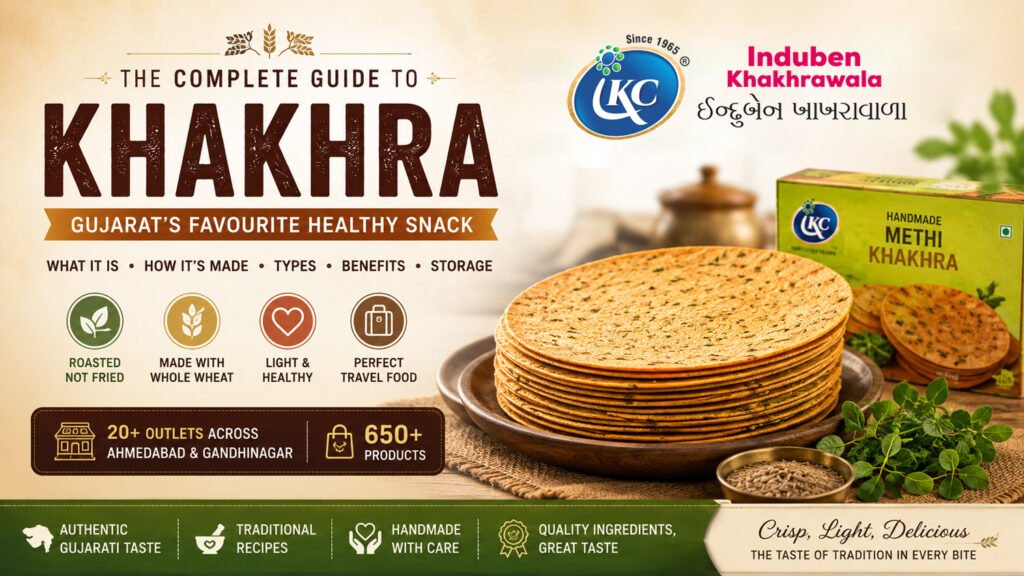
Aug
If you have ever opened a Gujarati household’s snack tin, you have almost certainly met khakhra — a thin, crisp, roasted wheat cracker that somehow manages to be breakfast, tea-time snack, travel food and midnight craving all at once.
But for anyone outside Gujarat, khakhra raises more questions than it answers. Is it a papad? Is it a roti? Is it fried? Is it actually healthy, or does it just look healthy?
This guide answers all of it — what khakhra is, how it is genuinely made, the difference between handmade and machine-made, the flavours worth trying, and how long a packet really lasts once you open it.
We have been roasting khakhra in Ahmedabad since 1965 — six decades, from one home kitchen to more than twenty outlets — so most of what follows comes from the tava rather than a textbook.
What is khakhra, exactly?
Khakhra is a thin, unleavened, dry-roasted flatbread from Gujarat, made primarily from whole wheat flour, and roasted until it loses almost all its moisture and turns brittle and crisp.
That last part is the whole point. A regular roti is soft because it holds moisture. Khakhra is roasted slowly and pressed repeatedly until the moisture is driven out entirely — which is why it snaps instead of folding, and why it keeps for weeks without refrigeration.
Three things define real khakhra:
- It is roasted, never fried. No oil bath at any stage. This is the single biggest difference between khakhra and most Indian namkeen.
- It is pressed while roasting. A cloth pad or wooden press flattens the dough against the hot griddle, forcing steam out and creating the characteristic blistered, uneven surface.
- It is dry by design. Low moisture means long shelf life — which is exactly why it became the traditional travel food of Gujarat.
The name comes from the Gujarati word for the crackling, rustling sound it makes when you break it. Anyone who has tried to eat khakhra quietly in a meeting knows the name is well earned.
Where khakhra comes from
Khakhra has deep roots in Gujarati and Jain food culture. Jain dietary practice places real value on food that is freshly prepared, free from certain ingredients, and — crucially — stable enough to eat without fermentation or spoilage. A dry roasted wheat cracker fits that requirement almost perfectly.
It also fitted the practical needs of Gujarat’s trading communities. Merchants travelling for weeks needed food that would not spoil, did not need reheating, and could be eaten plain or with pickle. Khakhra became the default answer, and stayed the default answer for generations.
That travel-food heritage is still relevant today — it is why khakhra remains one of the best Indian snacks to carry on a flight, and why so many of our orders go to families sending a parcel to a student abroad.
How khakhra is made
The traditional process has four stages, and each one affects the final result more than you would expect.
1. The dough. Whole wheat flour is kneaded with water, a little oil or ghee, and salt. Flavourings such as dried fenugreek leaves, cumin or spice masala go in at this stage — not sprinkled on afterwards. This matters: spices kneaded into the dough survive roasting and taste integrated, while spices dusted on top taste like seasoning sitting on a cracker.
2. Rolling. Each ball is rolled out extremely thin — considerably thinner than a roti. Thickness is where most khakhra fails. Too thick and the centre stays chewy; too thin and it burns before it crisps.
3. Roasting and pressing. This is the skilled part. The rolled disc goes onto a hot tava on low flame, and is pressed continuously with a cloth pad or wooden press, rotating constantly. The pressing forces out steam and prevents the khakhra from puffing up like a phulka. It takes two to three minutes per piece, and the person doing it is making constant small judgements about heat and pressure.
4. Cooling. Khakhra must cool completely before packing. Pack it warm, and trapped steam turns the whole batch soft within days. This is a genuinely common reason shop-bought khakhra disappoints.
Read more about how this process has stayed largely unchanged in our kitchen: the journey of Induben Khakhrawala from a home kitchen to a global brand.
Handmade vs Machine-made khakhra
Both exist, and both have a place. But they are not the same product.
| Handmade | Machine-made | |
|---|---|---|
| Surface | Uneven, blistered, slightly irregular | Uniform, smooth, identical every piece |
| Texture | Layered, shatters into flakes | Snaps cleanly, denser bite |
| Thickness | Varies slightly across the piece | Perfectly consistent |
| Flavour depth | More pronounced roasted notes | Milder, more uniform |
| Shape | Rarely a perfect circle | Precisely round |
The easiest test: hold one up to the light. Handmade khakhra shows uneven translucency — thinner in some places, thicker in others. Machine-pressed khakhra is uniform throughout.
If you want to taste the difference for yourself, start with our handmade plain khakhra, which is deliberately unflavoured so nothing hides behind spice.
Types of khakhra: a flavour guide
Khakhra has moved a very long way from plain wheat. Here is how the range breaks down.
The traditional four
These are the flavours that have existed for generations, and still account for most of what we sell.
- Plain khakhra — just wheat, salt and roast. The one to judge a khakhra maker by.
- Methi khakhra — dried fenugreek leaves kneaded into the dough, giving a mild, pleasant bitterness. The most popular flavour in Gujarat by a wide margin.
- Jeera khakhra — roasted cumin, warm and aromatic. Excellent with chai.
- Masala khakhra — a spice blend worked through the dough. Mild heat, not aggressive.
Pure ghee khakhra
Made with ghee instead of oil, which gives a noticeably richer aroma and a shorter, more delicate crumb. It is the version most people buy for gifting and for festivals. Our full range sits on the pure ghee khakhra page, including the pure ghee plain khakhra.
Multigrain and diet khakhra
For anyone watching refined carbohydrates or looking for more fibre:
- Ragi khakhra — finger millet, high in calcium and iron
- Bajri methi khakhra — pearl millet with fenugreek
- Math khakhra — moth bean, notably higher in protein
- Masala diet khakhra — lower oil, same spice
Modern and fusion flavours
This is where khakhra has genuinely reinvented itself for younger eaters:
Cheese khakhra · Mexican khakhra · Pani puri khakhra · Pav bhaji khakhra · Chaat khakhra · Fudina (mint) khakhra
We have covered the full ranking in our guide to the top 10 khakhra flavours to try.
Khakhra shots
Bite-sized khakhra pieces in a resealable tin — the same product, reformatted for people who want a handful at their desk rather than a full disc. Available as plain shots, methi shots and magic masala shots, among others.
Is khakhra healthy?
The honest answer: healthier than most packaged snacks, but not a free pass.
What works in its favour. Khakhra is roasted rather than fried, so it carries a fraction of the fat of chips, sev or ganthiya. Made from whole wheat, it brings fibre and takes real chewing, which slows eating. A single small piece is roughly 35 to 50 calories, depending on size, ingredients and oil content — modest for something that genuinely satisfies a savoury craving.
What to watch. Portion size is where people get caught out. Khakhra is thin and crisp, and three pieces disappear in about ninety seconds. Salt content also adds up if you are eating several a day, and some flavoured varieties carry more oil than plain.
Where it genuinely helps: as a replacement for fried snacks, as a school tiffin filler, as travel food, and as a base for a light meal when topped rather than eaten alone.
We have broken this down properly, with the caveats: is khakhra actually healthy?
How to eat khakhra
Plain, straight from the packet, is entirely legitimate. But khakhra rewards a little effort:
- With chhunda. The classic pairing. Sweet, tangy grated mango preserve against dry, salty khakhra — try it with our mango chhunda.
- With pickle and chai. Standard Gujarati evening. Mango pickle works best.
- As khakhra chaat. Crush, top with onion, tomato, sev, chutney and coriander. Ready in three minutes.
- As a khakhra pizza. Cheese and vegetables on a plain khakhra, two minutes under a grill. Reliably popular with children.
- With curd and jeera. Genuinely underrated. Plain khakhra dipped in seasoned curd.
- Alongside thepla. Two Gujarati travel staples together — our methi thepla is made for the same journeys.
Storage and shelf life
Handled properly, khakhra keeps for a long time. Handled carelessly, it goes soft in under a week.
- Unopened: approximately 4 to 6 months from manufacture for commercially packaged khakhra, depending on the product and packaging. Store cool and dry.
- Opened: transfer to an airtight container immediately. Two to three weeks of good crispness.
- Never refrigerate. Condensation is the enemy. The fridge is the fastest way to ruin a packet of khakhra.
- Keep away from the stove. Steam and heat both soften it.
- If it does go soft: thirty seconds on a dry tava on low heat, or two minutes in a low oven, restores most of the crispness.
Where to buy khakhra
We have been making khakhra in Ahmedabad since 1965. What began as one woman making khakhra for neighbours is now more than twenty outlets and a catalogue of over 650 products alongside the khakhra itself — the full story is here.
We roast fresh daily and ship across India. Browse the full range in our online store, or explore the wider Gujarati snacks collection if you want farsan and namkeen alongside.
If you want to try several flavours before committing, the traditional combo and exotic combo packs exist for exactly that. For gifting, the Induben Special Combo, our gift hamper and our Diwali gift boxes are the usual choice.
Travelling through Gujarat? You will find us at Ahmedabad Airport, at our Mithakhali store, and across our outlets in Gujarat and beyond — details on our contact page.
Frequently asked questions
Is khakhra fried? No. Khakhra is dry-roasted on a griddle with no oil bath at any stage. A small amount of oil or ghee goes into the dough, but the cooking itself is entirely dry roasting.
What is the difference between khakhra and papad? Khakhra is made from wheat flour and roasted on a tava. Papad is usually made from lentil or rice flour and is either fried or flame-roasted. Khakhra is thicker, more substantial and can be a snack on its own; papad is an accompaniment to a meal.
Is khakhra the same as roti? They start similarly but end up completely different. Roti is soft and eaten immediately. Khakhra is rolled far thinner and roasted much longer until all moisture is gone, giving it a shelf life of weeks rather than hours.
How many calories are in one khakhra? Roughly 35 to 50 calories per small piece, depending on size, ingredients and oil content. Pure ghee varieties sit towards the upper end of that range; plain and diet varieties towards the lower end.
Can diabetics eat khakhra? Whole wheat, millet and moth bean varieties are generally more suitable than refined-flour snacks because of their fibre content, and roasting avoids added fat. Portion size still matters, and anyone managing blood sugar should check with their doctor about what fits their plan.
Is khakhra good for weight loss? It can be a useful swap for fried snacks, since it is roasted and portion-controlled by nature. It is not a weight-loss food in itself — the benefit comes from what it replaces.
How long does khakhra stay fresh after opening? Two to three weeks in a properly airtight container, kept away from heat and humidity.
Can I carry khakhra on an international flight? Yes. Khakhra is dry, sealed and non-perishable, which makes it one of the more travel-friendly Indian snacks. Rules vary by destination country, so check your arrival country’s food import rules before you fly.
Which khakhra flavour should a first-timer try? Methi. It is the most popular flavour in Gujarat and the most representative of what khakhra is meant to taste like.
Induben Khakhrawala has been making khakhra in Ahmedabad since 1965. What started as one woman rolling and roasting khakhra in her own kitchen for neighbours and relatives is now a family business spanning more than twenty outlets, with a catalogue of over 650 traditional Gujarati products. Everything in this guide comes from six decades of doing it by hand. Read our story →
