


Khakhra Guides
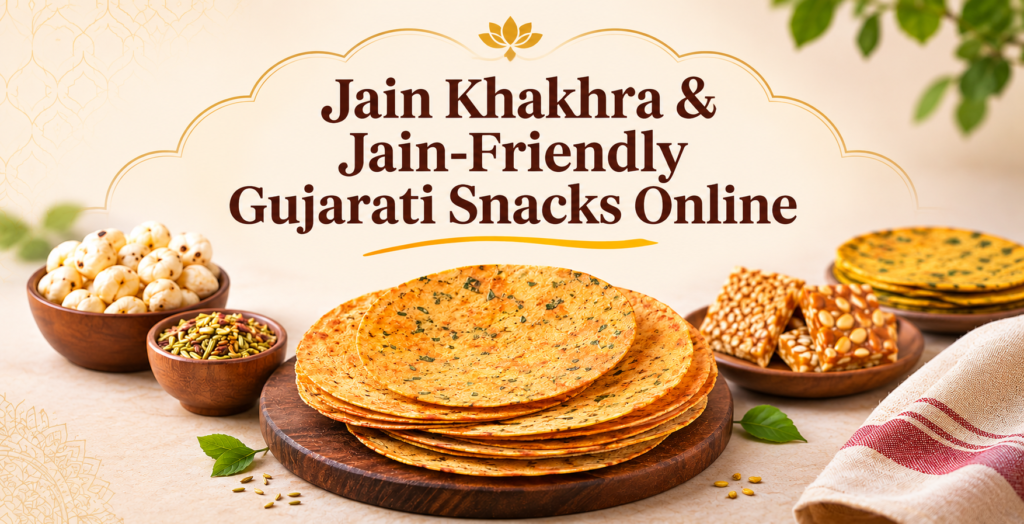
Jain Khakhra & Jain-Friendly Gujarati Snacks Online
Nov
Jain dietary practice rules out a great deal of what fills an ordinary Indian snack shelf. No onion, no garlic, no potato or other root vegetables — which removes most chaat masalas, most mixtures, and a surprising number of things that look harmless on the pack.
Khakhra is one of the few traditional Indian snacks that starts from a naturally compatible place. At its simplest it is wheat flour, a little oil or ghee, salt and a spice — and nothing in that list is a root vegetable.
This guide explains what Jain suitability actually means, which khakhra varieties sit comfortably within it, which ones need checking, and how to buy with confidence.
What makes a snack Jain-friendly?
Jain dietary practice avoids anantkay — root vegetables and underground produce — because harvesting them destroys the whole plant and the many small organisms around it. In everyday terms that means avoiding:
- Onion and garlic, in every form, including powders and pastes hidden inside blended masalas
- Potato, and anything built on it
- Carrot, radish, beetroot, ginger, turmeric root and other underground vegetables
Practice varies between families and communities. Some households are stricter than others, and some observe additional restrictions during Paryushan. Anyone shopping for a Jain household is best advised to confirm rather than assume.
Why khakhra suits Jain diets so well
Khakhra is a thin, unleavened wheat flatbread, rolled very thin and dry-roasted on a tava while being pressed until almost all its moisture is gone. That process involves no onion, no garlic and no root vegetable at any stage.
The base is simple. Wheat flour, water, oil or ghee, salt. Four ingredients, none of them problematic.
It is roasted, not fried. There is no shared frying medium to worry about, which is a common concern with fried farsan.
The traditional flavours are leaf and seed based. Fenugreek leaves, cumin seed, carom — all above ground.
Which khakhra varieties are generally suitable
Plain khakhra is the simplest of all — wheat, salt and roast, with nothing else to question. If you are buying for a household whose practice you do not know well, this is the safe choice.
Methi khakhra uses dried fenugreek leaves kneaded into the dough. Methi is a leaf, not a root. It is the most popular khakhra flavour in Gujarat by a wide margin.
Jeera khakhra is flavoured with roasted cumin — a seed, and a staple of Jain cooking.
Our pure ghee range follows the same recipes with ghee in place of oil, which many Jain households prefer for festival and gifting occasions.
Which ones to check before buying
Blended masala flavours need checking. Chaat masala, pav bhaji masala, Mexican and peri peri style seasonings very commonly contain onion or garlic powder. That applies across the industry, not to any one brand — and when a masala is bought in rather than made in house, even the maker may not hold the full ingredient breakdown.
Anything built on potato is out, which affects some mixtures and bhel-style products rather than khakhra itself.
“Vegetarian” does not mean “Jain”. Every product we make is vegetarian. That is a different and much lower bar than Jain suitability, and the two get conflated constantly.
Our position is simple: tell us an order is for a Jain household and we will confirm the exact contents in writing before it leaves the counter. We would rather answer the question properly than give a blanket assurance that does not hold for every item we sell.
Beyond khakhra: other naturally suitable options
Plain bhakhri. Plain bhakhri is thicker and sturdier than khakhra, made from the same basic wheat dough.
Mukhvas. Seed and spice mixtures eaten after meals — gujarati mix and tal gotli are built on fennel and sesame.
Roasted makhana. Plain makhana is fox nut, roasted. Check the seasoning on flavoured versions.
Chikki. Peanut chikki and til chikki are nut, seed and jaggery.
Thepla. Methi thepla is wheat and fenugreek leaf.
Buying for a Jain household
Read the ingredients, not the front of the pack. “Vegetarian” and “pure veg” tell you nothing about onion, garlic or root vegetables.
Be wary of blended masalas. If a label says only “spices” or “mixed masala”, ask.
Ask the maker, not the reseller. A shop that makes its own product can answer; a shop that buys it in often cannot.
Say so when you order. For gifting and bulk orders especially, flagging it at enquiry stage is far easier than unpicking it afterwards.
For gift hampers and corporate orders, mention Jain requirements when you call +91 81 41 41 5000 and we will build the selection accordingly.
Frequently asked questions
Is khakhra Jain-friendly?
Plain, methi and jeera khakhra are made from wheat flour, oil or ghee, salt and above-ground flavourings such as fenugreek leaf and cumin seed, with no onion, garlic or root vegetables. Heavily spiced and fusion flavours should be checked, since blended masalas commonly contain onion or garlic powder.
What does Jain-friendly food mean?
Jain dietary practice avoids root vegetables and underground produce — onion, garlic, potato, carrot, radish, beetroot and similar — because harvesting them destroys the entire plant. It is stricter than vegetarian, and practice varies between families.
Is methi khakhra suitable for Jains?
Fenugreek is a leaf rather than a root, so methi khakhra sits comfortably within normal Jain practice.
Does vegetarian mean Jain?
No. All Jain food is vegetarian, but most vegetarian food is not Jain. Onion, garlic and potato are vegetarian and are all avoided in Jain practice.
Can I order Jain-friendly gift hampers?
Yes. Mention it when ordering and the contents are confirmed in writing before dispatch.
Shop Jain-friendly ranges
- Handmade Khakhra — plain, methi and jeera, the varieties covered above
- All Khakhra — the full range, including millet and diet varieties
- Bhakhri — thicker wheat flatbreads
- Mukhvas — seed-based after-meal mixtures
- Makhana — roasted fox nut
- Pickles & Chhunda
Browse everything in our online store, or call +91 81 41 41 5000 to confirm Jain suitability before you order. See also our guide to bhakhri.
