


Khakhra
Handmade vs Machine-Made Khakhra: How to Tell the Difference
Aug
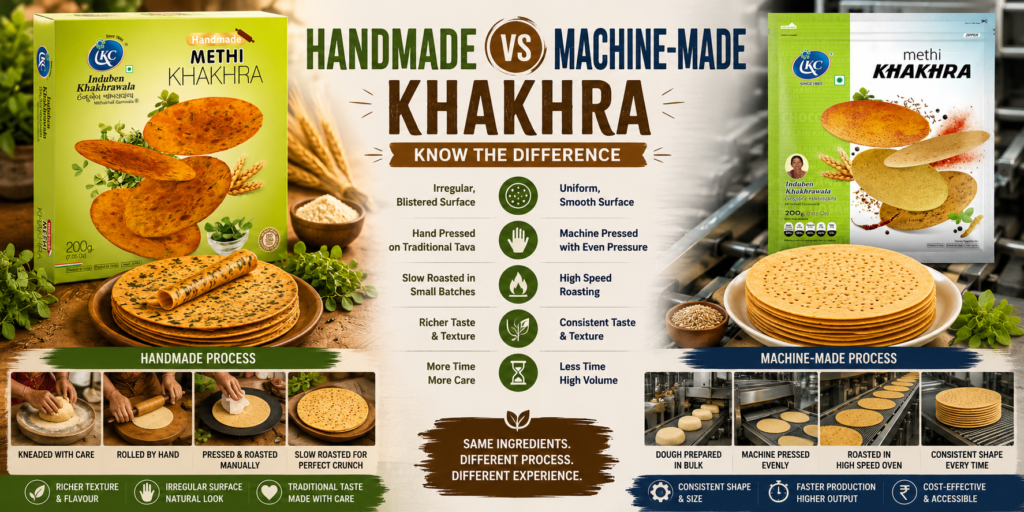
Pick up two packets of khakhra in the same shop and you may find one costs noticeably more than the other. Same flavour, same weight, similar-looking product. The difference is usually how it was pressed — by hand, or by machine.
Whether that difference is worth paying for depends on what you want from a khakhra. This guide explains what actually changes between the two methods, six practical ways to tell them apart before you buy, and — honestly — when the machine-made version is the better choice. If you’re new to the snack, our complete guide to khakhra covers the basics first.
The short version
| Handmade | Machine-made | |
|---|---|---|
| Surface | Uneven, blistered, irregular char marks | Uniform, evenly coloured |
| Shape | Rarely a perfect circle | Precisely round |
| Thickness | Varies across the piece | Identical throughout |
| Texture | Layered, shatters into flakes | Snaps cleanly, denser |
| Edges | Slightly ragged | Cleanly defined |
| Consistency | Varies piece to piece | Every piece identical |
| Price | Higher | Lower |
Neither is objectively “better”. They are different products that suit different purposes — which is why we make both.
What actually changes in the making
The dough is the same. The flour, the fat, the spices, the rolling — largely the same. The difference is concentrated in one stage: the roasting and pressing.
By hand, the rolled disc goes onto a tava over a low flame and is pressed with a cloth pad, rotating constantly, for two to three minutes. The person doing it is making continuous small judgements — more pressure here, the flame is running hot, this one needs another ten seconds. No two pieces get identical treatment, because no two pieces need it.
By machine, the disc passes through a heated press that applies uniform pressure for a fixed time at a fixed temperature. Every piece receives exactly the same treatment.
That single difference produces everything else. Hand-pressing creates uneven compression, which creates air pockets and micro-layers, which is why handmade khakhra tends to shatter into flakes rather than snap. Machine pressing creates uniform density, which is why machine-made khakhra breaks with a clean crack.
You can read more about how our methods have carried forward in the story of how the business grew.
Six ways to tell them apart
You can do most of these through the packet, before you buy.
1. Hold it up to the light. The most reliable test. Handmade khakhra shows uneven translucency — thinner and brighter in some places, denser in others. Machine-pressed khakhra glows uniformly across its whole surface.
2. Look at the char pattern. Hand-pressing produces irregular brown blistering, scattered unevenly. Machine pressing produces either a regular repeating pattern or an even overall colour.
3. Check whether it’s a perfect circle. Hand-rolled khakhra is almost never perfectly round. Slight ovals, small flat edges, minor irregularities. A flawless circle every time means a mould.
4. Compare pieces within one packet. Take out three and put them side by side. Handmade pieces differ visibly from one another. Machine-made pieces are near-identical — that consistency is the entire point of the process.
5. Listen to the break. Handmade khakhra tends to shatter, often into more than two pieces, with a softer crumbling sound. Machine-made khakhra usually snaps cleanly in two with a sharper crack.
6. Feel the edge. Run a finger around the rim. Handmade edges are slightly ragged and uneven in thickness. Machine-made edges are cleanly defined all the way round.
Does handmade actually taste better?
Honestly: it tastes different, and most people who grew up with khakhra prefer it — but “better” is doing a lot of work in that question.
What handmade genuinely gives you. The uneven thickness means some parts of each piece are more roasted than others, which produces more variation in flavour within a single khakhra. Thinner areas develop deeper toasted notes; thicker areas stay softer. Some people find that complexity is the whole appeal. The layered texture also holds toppings better, which matters if you’re making khakhra chaat.
What it costs you. Consistency. In a handmade batch some pieces will be slightly darker, slightly thicker, slightly more done than others. That is inherent to the method, not a defect — but if you want every khakhra to taste exactly like the last one, handmade will frustrate you.
Where the difference is smallest. In heavily flavoured varieties. With cheese, pani puri or chaat khakhra, the seasoning dominates and the subtleties of pressing matter less. The difference is most obvious in plain khakhra, where there is nothing to hide behind.
When machine-made is the better choice
We would be doing you a disservice if we only argued one side.
When you want predictability. Retail, catering, hampers, anything where every piece should look the same. Uniform product looks better in a gift box.
When cost matters. Machine production is more efficient, and that shows in the price. If khakhra is a daily staple in your household rather than an occasional treat, the economics are real.
When you’re using it as an ingredient. Making khakhra pizza or crushing it into chaat? Uniform thickness cooks and crushes more predictably. The nuances of hand-pressing get lost the moment you put cheese on top.
For children’s tiffins. Consistent thickness means consistent portions, and children tend to be less interested in the artisanal argument than adults are.
Why handmade costs more
The price difference isn’t a premium for the label. It reflects genuine differences in production:
- Time. A skilled worker presses one khakhra at a time. A machine produces many simultaneously.
- Skill. Hand-pressing takes real training. Judging heat and pressure by feel is not something learned in a week.
- Yield. More pieces are rejected. Hand-pressing produces more variation, and some of that variation falls outside what should be sold.
- Scale limits. Handmade output is capped by how many trained people are working, not by machine capacity.
What to look for when buying handmade khakhra
- Check the pack states it. “Handmade” should be on the packaging, not just implied by the photography.
- Look for the visual signs above through the window, if there is one.
- Buy from somewhere that makes it themselves. Resellers often can’t tell you how a product was made.
- Check the manufacturing date. Handmade batches are smaller and turn over faster — a very old date on a handmade product is worth a question.
- Start with plain. Order handmade plain khakhra first. With no flavouring to distract you, the difference in method is at its most obvious.
Our handmade range
We make our handmade khakhra in four traditional flavours:
- Handmade plain khakhra — the benchmark
- Handmade methi khakhra — fenugreek, the most popular flavour in Gujarat
- Handmade jeera khakhra — roasted cumin
- Handmade masala khakhra — spice blend worked into the dough
All four are available in 500g packs for regular households.
For a richer version, our pure ghee khakhra range uses ghee instead of oil. To try several at once, the traditional combo is the usual starting point, and the full range is in our online store.
Curious about the nutrition differences between varieties? Our khakhra calories and nutrition guide breaks down all ten, flavour by flavour.
Frequently asked questions
How can I tell if khakhra is handmade? Hold it up to the light. Handmade khakhra shows uneven translucency, irregular char marks and a shape that isn’t a perfect circle. Machine-made khakhra is uniform in colour, thickness and shape, with every piece near-identical.
Is handmade khakhra healthier than machine-made? Not inherently. Nutrition comes from the ingredients — flour, fat, spices — not the pressing method. If the recipes are the same, the nutritional profile is essentially the same.
Why is handmade khakhra more expensive? It takes more time and skill per piece, produces more rejects, and can’t be scaled the way machine production can. The price reflects labour, not branding.
Does handmade khakhra last as long? Yes. Shelf life comes from moisture removal and packaging, not from the pressing method. Both keep for approximately 4 to 6 months unopened when properly packed.
Is machine-made khakhra bad quality? No. It’s a different process with different strengths — consistency, uniform appearance and lower cost. For everyday eating, gift boxes and cooking, machine-made is often the more practical choice.
Which should I buy first? If you have never compared them, buy handmade plain khakhra. Plain has no flavouring to mask the texture, so the difference in method is easiest to notice.
